
The White Front
The last miner's bar in Philipsburg

Hi friends, it has been quiet for a few weeks and I wanted to say I am here, I have been writing, but I have also been hiking, going home for a long weekend, working quite a bit, and juggling that hectic cocktail of things that add up to Life. Thanks for sticking around! This is another bit in my on-going series about the watering holes that I love, that intrigue me, that deserve a bit of notice. This is about The White Front, a sturdy old bar that has outlasted its brethren. In a town that has tied its fate to tourism, this bar nods to a time before Philipsburg, Montana plied her wares to visitors. Join me for a chat about tourism, greed, mining, and falling in love with my home state partially in part because of this bar on a July night.
Whether it’s the 1880s and the gold dries up, or the 1980s and the silver finally peters out, many communities in Montana must at some point be creative when it comes to finding new ways to stay alive. This often requires making deals with the devil that is capitalism - finding new ways to get cash into town while not luxuriating in options. For these towns, tough bargains and hard times are nothing new. Resource extraction, the speciality since white folks came out here in the mid-19th century, puts a heavy burden on communities and workers both short and long term, while the people dependent on the very bounty that Nature provides must blast, dig, fell, and take in all other manners from her in rabid fashion in order to keep their heads above water.
Philipsburg, Montana is today a gleaming jewel of a tourism-centric village, but was once, and for over 110 years, a less buttoned up mining town. First gold, then silver, made a few people rich, and kept enough families on their feet that the town didn’t blow away in the winds of time like dozens of other mining camps. While today you can stroll down a damn cute Broadway Street and buy delicious fudge at The Sweet Palace and a block away relish some of the best beer in Montana at Philipsburg Brewing Co. (Otter Water is one of my favorites), this peacocking little town dotted with brightly painted Victorian architecture and magnificent brickwork still has a few places that wink (leer?) to a not-so-distant past. This past is, as you probably guessed, more honest and less than the somewhat shellacked faux-West vibe that emanates today.1
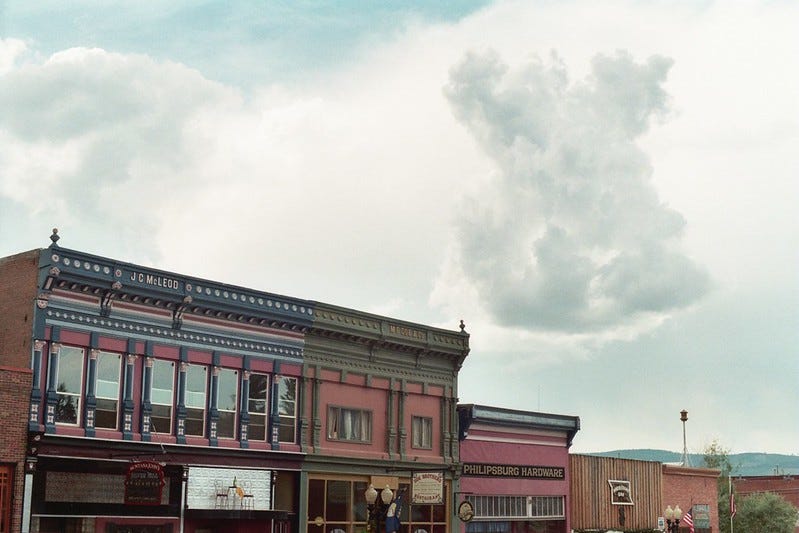
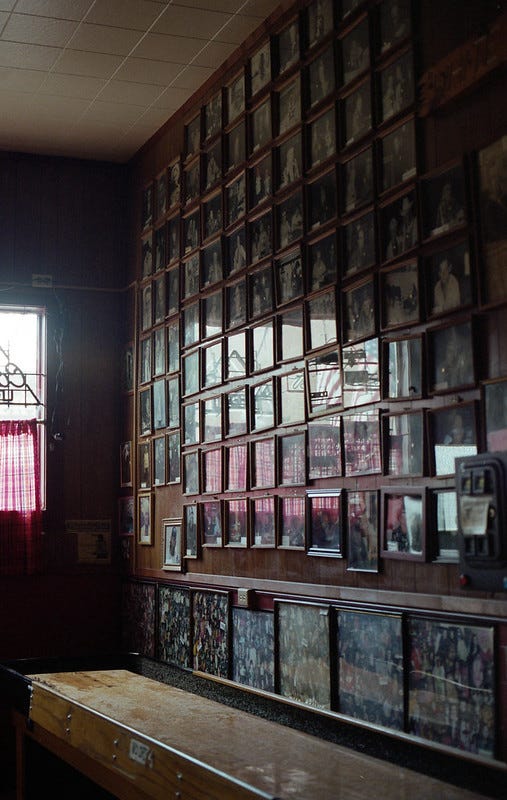
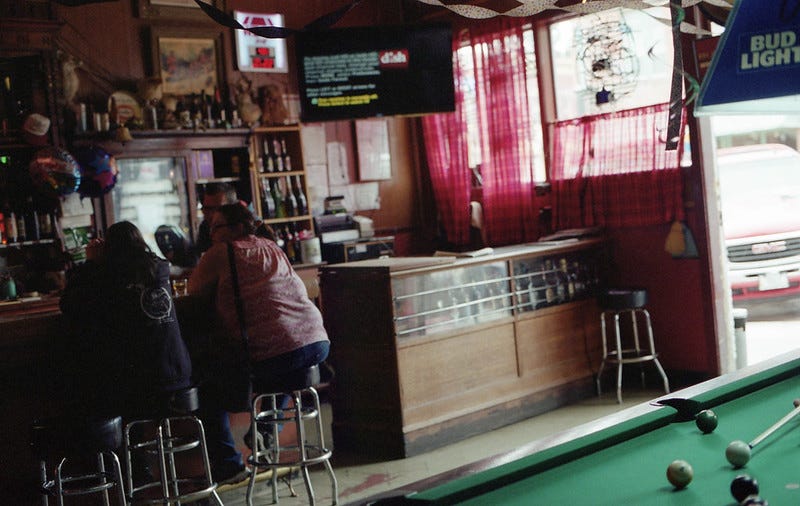
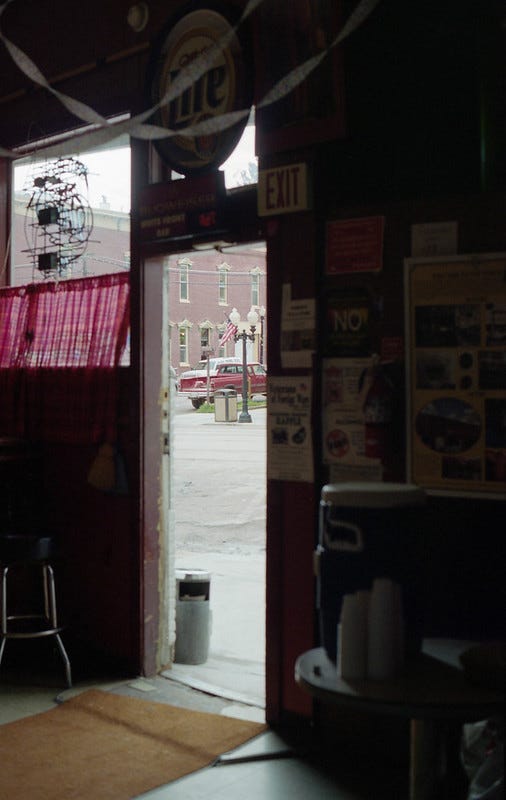
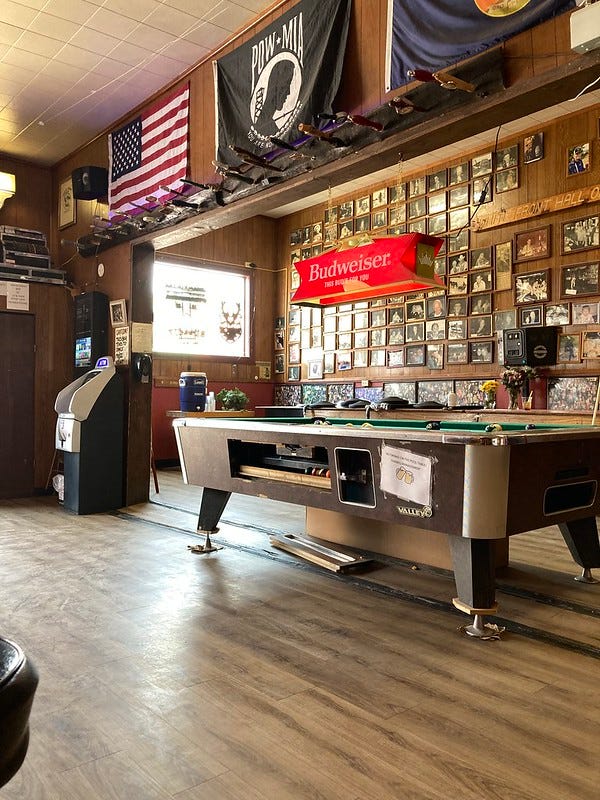
Cue The White Front coming into the scene: a slightly dingy, character-filled bar offering passerby a window into a past that is not chic, not cute, not convenient. Along a block made up of an elegant real estate office, two restaurants, and a vintage shop, this bar sticks out or seems invisible, depending on the person and their whims. The front door to this time capsule is often propped open on nice days. There is usually somebody smoking outside. Inside, there is a bar cavernous, dank, and absolutely full of memorobilia, among them scantily clad ladies on decades-old posters advertising light beer, and a wall of old photographs near a pool table. A POW-MIA flag hangs next to American flag. The bartender may or may not be wearing sweatpants and bring that level of fucks given to the entire experience.
You’re in the last remaining miner’s bar in a town that no longer has mining. Welcome.

My connection to The White Front is flimsy but real. I’ve only been three or four times, and never long enough. Once on a summer night, once in May, once in October, and once in August. Each time, I always leave with so many questions sticking like burrs to the back of my mind, and the temptation to go overboard. Such is going to a bar where the miners used to party until the sun came up.
This watering hole is a bit of a black sheep at this point, the old wooden and white brick facade a bit tacky and dated, and the entire thing looking happily uninviting to the general public. (I mean, there are curtains hanging in the windows.) I like places that take up space like this, that are, without meaning to be, inherently defiant in the face of the influx of cash and new, more moneyed faces. I love that this building is literally next door to a real estate office. It feels like a nice (and nicely spiteful) counterweight, especially when the real estate office is selling local houses that are close to a million dollars in a state with an on-going housing crisis. The White Front is the right place to experience Pburg as she was, weighed down with charismatic, approachable reality rather than held up loftily with dreams many locals never will be able to afford. Also, if I’m being honest, The White Front hints at excess in a way that puts a twinkle in your eye. I like a place that whispers to you to be a little bit over the top. It’s obvious the patrons in past decades absolutely were.
Now, I am being slightly flippant about Philipsburg as she is now, with her California-owned buildings and her steak house and whiskey bar and $800k homes. In the 1980s, this town was about to pass into the shadows of memory. The silver was gone. The mines were closed or closing. Richard Hugo wrote a wonderfully bleak, depressing poem about the place that is frequently quoted by people who knew about these dark days. Sure, there was a Forest Service office and that kept some people in work, and ranching kept some folks busy, but it wasn’t enough. There wasn’t money, there wasn’t a future. There wasn’t anything to ply that anybody consistently wanted, except some very cute buildings and a fair bit of charisma buried under dank layers of economic depression.
Then came Shirley Beck, described by a defunct but often delightfully salacious Wordpress blogger (who remains anonymous and writes jaggedly) who clearly has connections to this part of Montana, thusly:2
She is a Main Street evangelist, a a one-woman Chamber of Commerce buzz-saw.
Energy pours from her like water gushing from an open main. And in the past two decades Beck, in association with partner Dale Siegford, has carved a retail empire on the streets of nowhere.
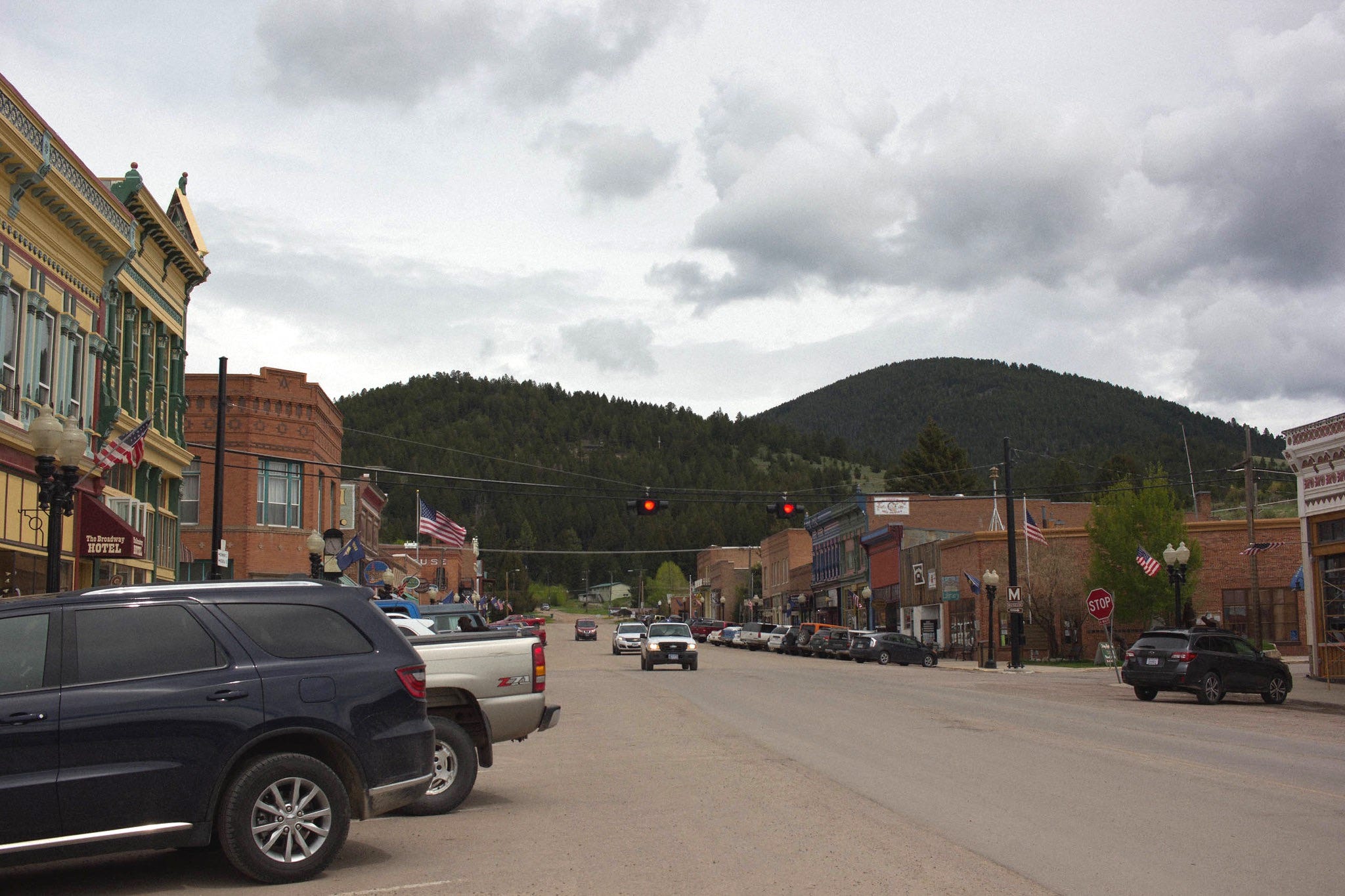
If you know Philipsburg, you know Beck. You know the work she’s done, the way that she brought new life here, pissing off people and charming others along the way. Starting in the 1990s, she began buying businesses, re-vamping them and slowly making PBurg’s pulse a bit stronger. She didn’t come from money; she financed things with credit cards, trained her kids to work the stores, and year after year paid off her loans and kept her eye on a prize. You cannot escape Beck or her vision here, and you have to respect it. Few people have this consistent energy, this veracious attitude that a place like Philipsburg could be more than the anemic town it looked doomed to be.
Whether or not she intended it to, though, Beck’s vision-turned-reality for Pburg’s renewal is resolutely tied to tourism. There are reasonable qualms to be had striking a bargain with an industry that devours its own easily, readily, and frequently.
As we’ve seen the current twenty-car-pile-up of challenges in Montana, tourism is not the darling that she appears to be. She brings real estate crises that drive out locals. She brings about unchecked greed, encouraging a new class of feudal assholes who live off AirBnb and other rental feifdoms (there are 28+ AirBnb units alone in Philipsburg, a town that has less than 1,000 people living there year-round, not to mention many more in nearby Anaconda and Georgetown Lake).34 Local paychecks almost always stay the same while cost of everything goes up. Tourism brings out the worst in many of us, too, who begin to feel like we’re on display in our newly desirable hometowns, barely making rent while somebody in a Mercedes adventure van casually ogles our town like a buffet and scrolls on Zillow.5 Many places that decide that tourism will be their saving grace rarely successfully put in place measures to balance and maintain the local ecosystem, inhabitants, and way of life, whether due to short-sightedness or politics or bureaucratic red tape.
This is where The White Front comes in. I doubt that a nice couple from Virginia in their RV want to spend their limited, precious time in a place where there are faded curtains, Lays chips for food, and lots of shadowy corners. The bar self-regulates that way, like many proper dives do, maintaining its own ecosystem successfully by remaining as it was in the 70s or even earlier, back when the town’s paychecks didn’t depend on folks passing through. This place hasn’t done much to cater to new folks, but they’re welcome in.
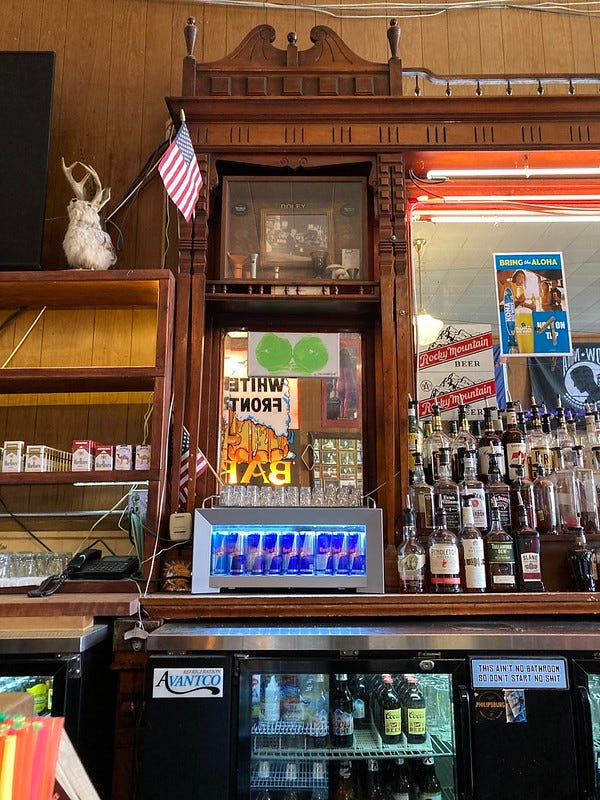
Tracking down The White Front’s history has been particularly difficult this go-around. I know that the building is wood, from the 1880s, and has hosted numerous businesses. I cannot figure out when exactly the bar opened, though. I’ve scoured all the Sanborn insurance maps I can find online. There are no newspaper articles I can find that tell me more. I found the obituary of a man who used to own the bar, a Gregory “Scott” Anderson who traded his logging truck in his twenties for buying the bar in the 70s. Sadly, his obituary doesn’t say much about the many adventures Anderson surely had while running the place, but it does make him sound like the rollicking kind of guy who would run a bar like the White Front:
“Scott was a man of many skills; you could say he tried just about everything. From bullfighting, firefighting, carpentry, and everything in-between. His pride and joy though was owning his two bars. Scott loved to entertain and was known for throwing “over the top” parties. He was a friend to everyone and thrived on helping out the communities he lived in. Anyone that knew Scott has at least one wild story about or with him.”
Having worked in liquor service long enough, and having been around (and been myself) part of the crew of folks that keep our bars, taprooms, and pubs afloat, I have an inkling of what Anderson may have been like. That being said, I think I hit a dead end. This bar, wonderful and important to the town, a central player in many a tale, is still a local bar in a town that was never big.
The stories, the history, is carried in the walls and in the memories of her former patrons, in the well-worn tales that regulars once told, not in a newspaper or official archives. The past lives in face to face chats with people whose lives weren’t big or glamorous either. Toiling in mines, cutting down trees, maintaining a little claim in the hills wasn’t for the faint of heart, but it was also hardly unusual. The stories to be heard are in the photographs of men on the side wall, many of them the miners who gave life to the town while hollowing out her hills. Per the Montana blogger who drinks and talks his way around Pburg, a star on the photograph means they’re dead. I’m not sure if this custom is being kept up.
Many miners worked hard and played harder. The White Front used to host the itinerant miners, the ones who traveled a mining circuit around Idaho, Colorado, Wyoming, and Montana. These men would make the bar stay open until eight in the morning, talking, partying, brawling. Per one Leroy Owens, former miner,
“Here was an old saying, when they were in bar, all they ever talked about was mining. And when they were up here mining, all they talked about was the red-light district in Butte.”
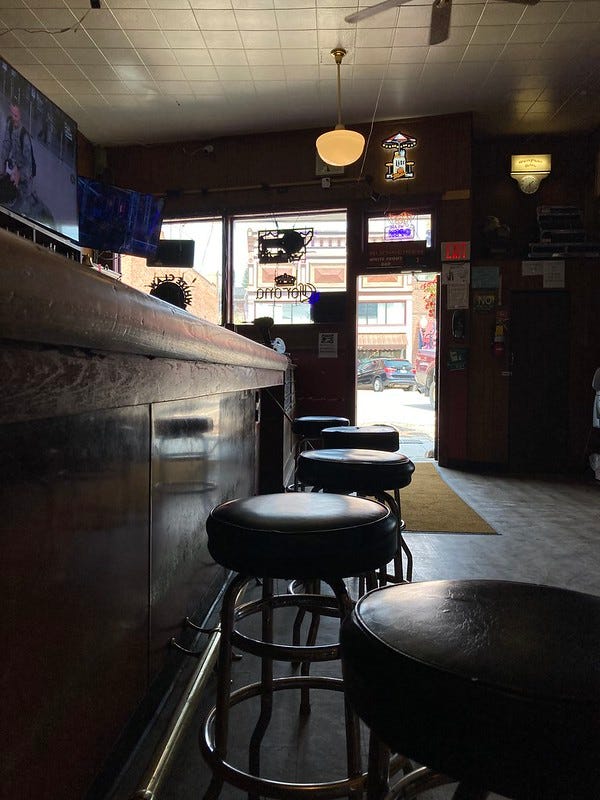
So, we know The White Front was a place of lust, of excess, of blowing off steam, of spinning yarns. The hard living workers of these resource extractive jobs are largely gone, retired, or dead now. A lot of their kids and grandkids are still in town, because Pburg has a weird vortex-like pull, but the mining is gone. While that’s not entirely a bad thing (the environmental remediation that must happen after a mining operation, even small scale, is through is both terrible and fascinating), it does strip towns like Pburg and Butte and Anaconda down to locales that often rely on mythology and slightly apocryphal history whether they intend to or not.
Before the mines closed, The White Front was just one of many local bars that served the miners, timber men, ranchers, and other workers who made Pburg home. You had the Antler Bar, the M&M, The Club Bar. For anybody who's been around for the forty years or so since the mines have closed down, The White Front is the last man standing on the main drag. Everything else is shinier, newer, but slipperier too. Give me the lived in places like this bar, the places that let me ask questions and find answers, that are emanating with an energy that can only be earned by decades of mischief and excess.
So, here’s my mythology about the place. If the historian in me can’t nail down a lot of hard facts about The White Front, the storyteller in me can tell you about my first introduction, because it was magical.
It was high summer, maybe July, of 2013. I was visiting my friend Chelsea, who was working nearby at a political non-profit. We had driven the twenty minutes or so down dirt roads into town, and the allure of the warm light coming from The White Front was awesome with the overall darkness of Broadway Street. The air outside was the same temperature as inside. The place was full of people, many young like us. I was instantly charmed by this bar, by the high ceilings and hundreds of photographs and the sketchy bathrooms and the mirrored, old wooden barback. I am pretty sure there was dancing. Even then, I was picturing what kind of folks had been there before me. I knew places like this, but had rarely wandered in.
I was a twenty two year old Art History student in Bozeman, before Bozeman went nuts, and it was a summer full of cold PBRs chilled in the creek, of getting drunk and watching barrel racing at the Mineral County rodeo, going to the Boiling River in Yellowstone, working 10 hour days at the Forest Service so I could have three day weekends camping in the Tobacco Roots and going to the fair and seeing shows in Missoula. My sister was working in Yellowstone and I visited her, becoming temporarily infatuated with a bush pilot from Tennessee working in the park. My little Saturn put some serious miles on that summer, but I am fondest of that night in Pburg, being so ridiculously charmed by this bar, by this stubborn old bar still standing bright on a dim street. I think that summer I finally fell in love with my home state of my own volition, and the White Front had a part in it. That’s why I drag my friends and family there when we’re in Pburg, because it played a role in my own mythology, of how I came to love where I’m from so much, so fiercely, so honestly. Warm lights, cold beer, and a lot of history and lore to engage with. What more could a girl ask for?
If you go to The White Front, it’s probably cash only but I cannot recall. Tip your bartenders well. Don’t be surprised if a dog wanders in. Thanks for coming to another beloved bar in the Rocky Mountain West with me. Be well, friends.
I do not begrudge Pburg’s 180 turn to a tourism mecca, but I do want to acknowledge that there is a strangeness to it.
This blog went from 2011 to 2014 and the author never made an “About” section, so they shall remain anonymous.
It set off a red alert level BEEEEP BEEEEP in my head when I found out several years ago that even Anaconda has become a hot commodity. Nowhere in Montana is safe from the clutches of out of staters!
Just down the street from The White Front is a real estate investment company ran by a self proclaimed “tech executive” who touts his long time real estate investment background. Blegh.
Don’t get me started on the years of collective work that towns like mine and others have to put in to make themselves liveable and enjoyable. It takes a village to keep trails open, work with landowners to keep gates unlocked, to do annual trash pick-ups at the creeks and rivers, to rally local politicians to do the right thing during the legislative session, fundraise for the library or sick kids in town, etc. When those desirable places becomes a place of convenience for more well to do folks, these folks feel no obligation to maintain the systems that we’ve been building and keeping up for as long as we can remember. A lot of new folks don’t know it, but they often act like parasites.